
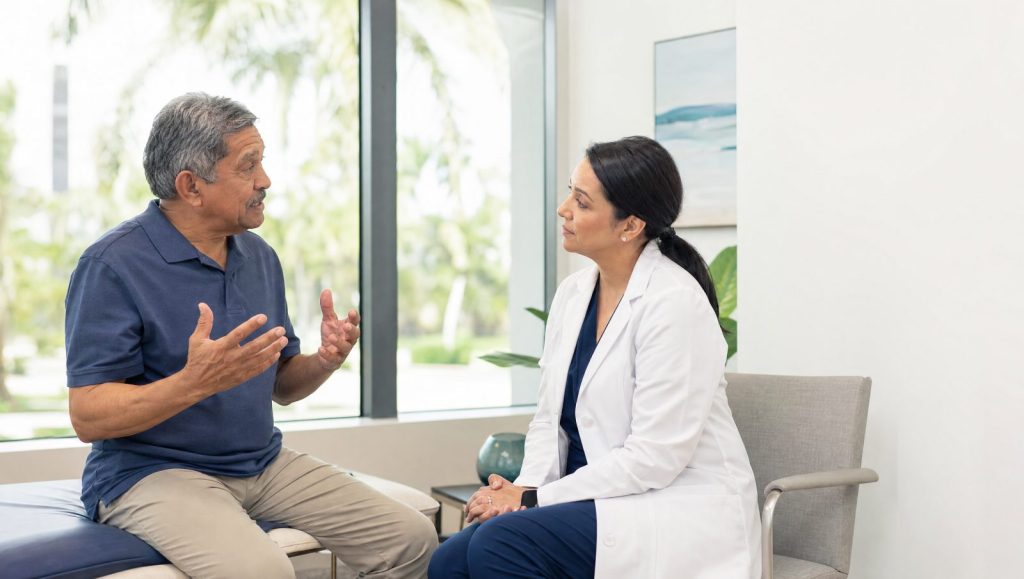
Searching for bilingual doctors in West Palm Beach is not about convenience. For older adults managing several conditions at once, being able to explain symptoms precisely, in your first language, is a patient safety issue, and it changes how well treatment actually works.
Table of Contents
Why Language Affects Health
Medical care runs on description. How sharp is the pain, how long has it lasted, does it move, what makes it worse. Those distinctions are difficult to convey in a second language, especially under stress, and they are exactly what a physician needs to reach the right diagnosis.
For seniors the stakes compound. Older adults are more likely to manage several chronic conditions, take multiple medications, and receive instructions that must be followed precisely. Every one of those depends on clear two-way understanding.
- Symptoms get described with the detail that leads to an accurate diagnosis
- Medication instructions are understood the first time, reducing dosing errors
- Patients ask more questions when they are not straining to translate
- Follow-up care and screening schedules are more likely to be completed
What Gets Lost in Translation
Relying on a bilingual family member seems practical, and families do it constantly. It also introduces real risk. An adult child translating for a parent is doing unpaid clinical interpretation with no medical vocabulary, while emotionally involved in the outcome.
Patients also self-edit in front of family. Symptoms involving memory, mood, incontinence, falls, or alcohol use are frequently softened or left out entirely when a son or daughter is doing the translating.
- Clinical terms get approximated rather than translated precisely
- Sensitive symptoms go unreported to avoid worrying family
- Nuance about severity, frequency, and duration is flattened
- The family member carries responsibility they were never trained for

Beyond the Exam Room
A practice is only genuinely bilingual if the language holds up at every step. Many offices advertise Spanish-speaking physicians while the phone line, intake forms, billing questions, and pharmacy instructions all revert to English.
That gap matters. Most of the friction in healthcare happens outside the exam room, at the front desk, on the phone, and at the pharmacy counter.
- Scheduling and reminder calls handled in your language
- Intake and consent forms you can actually read before signing
- Insurance and billing questions answered without a language barrier
- Prescription and pharmacy instructions explained clearly
- Community events and wellness programming offered in Spanish

How to Find a Bilingual Practice
A directory listing that says Spanish is a starting point, not an answer. These questions separate practices that are genuinely bilingual from those that list it as a feature.
- Does the physician speak Spanish directly, or is an interpreter dialed in?
- Can I schedule and handle billing questions in Spanish by phone?
- Are written instructions and forms available in Spanish?
- Do you accept my Medicare or Medicare Advantage plan?
- Are labs, imaging, and pharmacy available on site?
- Is help with transportation available if I cannot drive?
What to Expect at Your Visit
At a genuinely bilingual practice the language stops being something you manage. You describe what is wrong the way you would describe it to family, and the clinical work happens around that.
Expect a longer first appointment while your history, medications, and specialists are documented properly, and expect to leave understanding what happens next.
- A full history and medication review taken in your language
- Time to ask questions without translating them first
- Written follow-up instructions you can read at home
- Referrals and lab orders explained before you leave

Spanish-Speaking Care at Cagigas
Cagigas Medical Centers was built around a Spanish-speaking senior community in West Palm Beach, so bilingual care is the default rather than an accommodation. Our providers, front desk, and support staff all speak Spanish.
Everything sits at one address at 1401 S. Military Trail: primary care and specialists, laboratory, diagnostics, pharmacy, and our Wellness Center. We also run a weekly activities calendar in Spanish, and offer citizenship services for patients working toward naturalization.
- Bilingual physicians, front desk, and support staff
- Most Medicare and Medicare Advantage plans accepted, verified before your visit
- Labs, imaging, pharmacy, and wellness services under one roof
- Transportation assistance for eligible patients
- A weekly community activities calendar in Spanish
Frequently asked questions
Do I need to bring my own translator?
Not at Cagigas Medical Centers. Our providers and front desk staff speak Spanish, so you can book, describe symptoms, ask questions, and understand your treatment plan without relying on a family member to translate.
Are appointments available fully in Spanish?
Yes. From scheduling through the visit itself, follow-up instructions, and prescription guidance, the entire experience can be conducted in Spanish.
Do bilingual doctors in West Palm Beach accept Medicare?
Many do, and Cagigas Medical Centers works with a range of Medicare and Medicare Advantage plans. Because networks vary by plan, call (561) 429-3122 so we can confirm your specific coverage before your first appointment.
Can family members join the appointment?
Absolutely, and we encourage it for seniors managing several conditions. The difference is that family members can be there for support rather than being responsible for translating medical information accurately.
What if I need help getting to my appointment?
Transportation assistance is available for eligible patients in the West Palm Beach area. Ask our team when you schedule and we will let you know whether you qualify.
Talk to a Bilingual Doctor in West Palm Beach
Describe your symptoms in the language you think in. Our bilingual team will confirm your Medicare coverage and get you scheduled at 1401 S. Military Trail.